



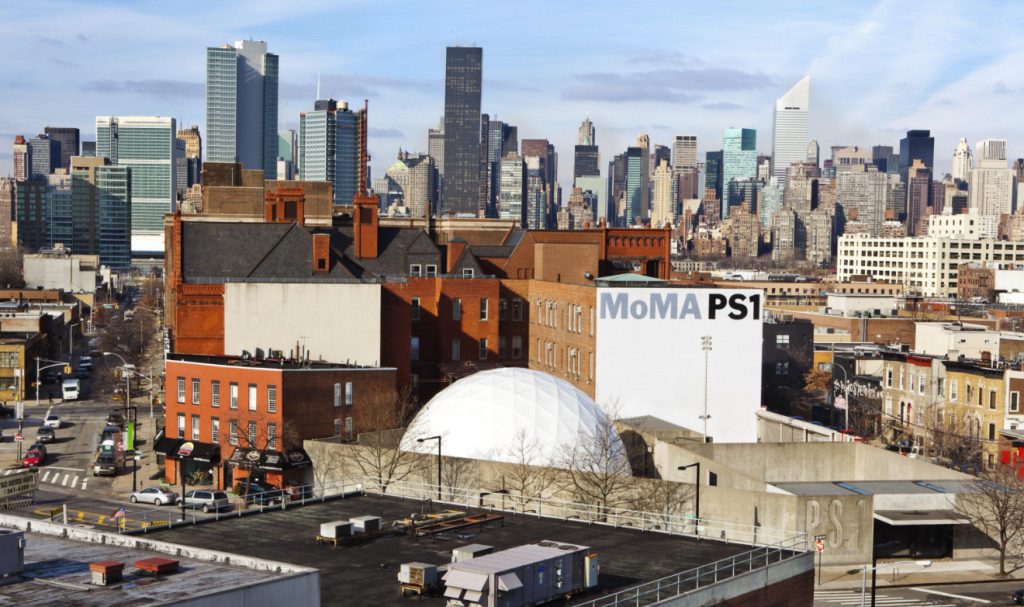
The building houses MoMA PS1 was opened as a school in 1892. Photo via iloveny.com
The art institute is a monument to LIC’s corrupt, charismatic mayor.
GEOFFREY COBB | gcobb91839@aol.com
Author, “Greenpoint Brooklyn’s Forgotten Past
LONG ISLAND CITY — The massive red brick building that occupies an entire block at Jackson Avenue is easily Long Island City’s most dramatic. More like a citadel than a former school, PS 1 with its massive gables and beautiful ornamental terra cotta stands out against the sea of monotonous glass and steel skyscrapers that have sprung up in the area like mushrooms after a spring rain.
Exuding nineteenth century majesty and elegance, PS 1 is one of the most successful repurposed buildings in the city, but few of its visitors are aware of the structure’s fascinating early history. Its beautiful terra cotta floral motifs were the creation of the nearby New York Architectural Terra Cotta Company, a legendary firm whose work graces many of the city’s most beautiful buildings. The building was once even more majestic. When it opened in 1892 it boasted a stately clock tower, a bell and capacity for a thousand students.
The school was the crown jewel of one of the most colorful characters in the history of New York City Politics, Patrick “Battle Axe” Gleason, the last mayor of an independent Long Island City before LIC was absorbed into the five-borough metropolis in 1898. As flamboyant and charismatic as he was corrupt and deceitful, Gleason earned his nickname when he and his fire department wielded axes to cut down a Long Island Railroad wooden fence that blocked residents of LIC from reaching their waterfront without purchasing a ticket.
Many of Gleason’s supporters were Irish immigrants who lived in squalid tenements and toiled in LIC’s many factories and refineries. Gleason reckoned that if parents saw the elegant school he had built for their children, they would vote for him, but the reality was different. Many LIC residents expressed shock and indignation at the astronomical cost of building Gleason’s First Ward School, $225,000, a massive sum in 1892. The terra cotta masterpiece, which nearly bankrupted LIC, became a massive source of patronage and kickbacks for the shifty Gleason. Accusations of graft and corruption made headlines in several newspapers. The scandal surrounding the First Ward School helped to secure Gleason’s defeat in the 1892 mayoral election.
Fascinated by this architectural gem, I searched for hours in vain trying to discover the architect of the school. In desperation, I turned to the Guru of Long Island City history Mitch Waxman, who informed me that no one knew for sure. Many of Long Island City’s records were lost or destroyed when the area merged with New York City, so the identity of this talented architect remains a mystery.
The school served as an educational institution until 1963, when a precipitous drop in the area’s school aged population forced the closure of Gleason’s showcase and it became a New York City Board of Education warehouse. For years, it sat vacant, a forlorn elegant white elephant slowly succumbing to neglect, a ghost of its former self in a neighborhood that had seen better days.
The building was slated to be sold by the city to as a factory site, but thankfully the sale never occurred. In 1972, the Institute for Art and Urban Resources Inc., a non-profit founded by visionary Alana Heiss, purchased the derelict building to provide studios and exhibition space for the city’s artists. In 1976, after extensive renovations, Heiss opened the P.S. 1 Contemporary Art Center, greatly increasing the institute’s exhibition and studio capacity. P.S.1 helped spark a revival of LIC and in 2000 P.S.1 began its formal association with New York’s Modern Museum of Art, becoming MoMA PS1.
In the last quarter century, MoMA PS1 has become world famous for its experimental, site-specific art shows, hosting landmark exhibitions like the recurring “Greater New York” survey, James Turrell’s long-term installation Meeting, and other critically acclaimed installations, including retrospectives for Mike Kelley and Maria Lassnig, and thematic exhibitions like Into Me/Out of Me and WACK! Art and the Feminist Revolution. One of the oldest nonprofit contemporary art spaces in the US, P.S.1 serves as a mecca for emerging artists, innovative installations, and immersive exhibitions, drawing visitors from around the world.
The school played a role in the final chapter of the Paddy Gleason story. Though Gleason was a highly controversial figure amongst adults, he was loved by the area’s children. When he died in 1901, his funeral procession was slated to pass by the school. When the students’ demand to pay their final respects to Gleason was dismissed by the principal, they staged a massive walk-out, demanding that they be allowed to stand outside the school and say a last goodbye to its patron. Fearing a revolt, the principal relented and hundreds of youngsters lined Jackson Avenue to mourn Gleason. Gleason might have wildly overspent on his showpiece school, but future generations can thank him for building this elegant LIC landmark.