



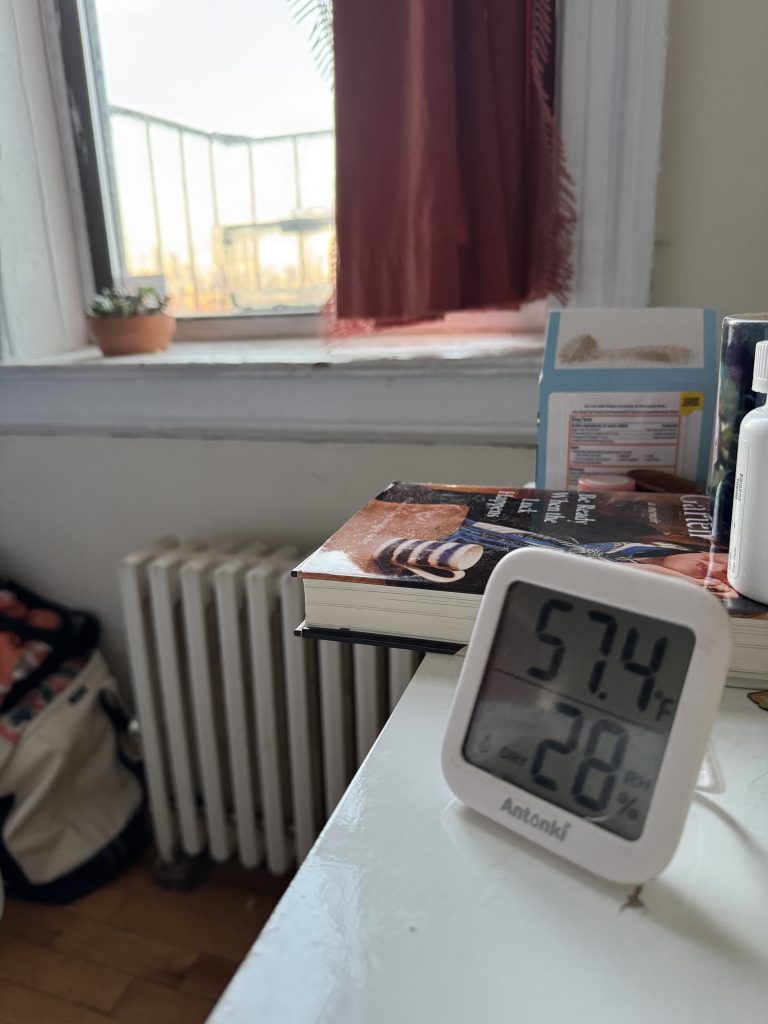
The temperature inside Josi Gula’s apartment regularly dips below 60 degrees each winter.
By COLE SINANIAN | news@queensledger.com
ASTORIA — When the outdoor temperatures plunged into the single digits last week, Josi Gula was shivering in her bed as the mercury in her apartment hit 56 degrees fahrenheit for the third year in a row.
Each winter since 2024 her heat would turn on and off sporadically — sometimes for long periods — often leaving her and her husband freezing in their one-bedroom apartment.
Gula lives at 32-52 33rd Street in Astoria, in a six-storey, 98-year-old building owned by the notorious landlord A&E Real Estate holdings, a company whose CEO — Margaret Brunn — was named NYC’s “worst landlord” of 2025 by Public Advocate Jumaane Williams. A&E, which has nearly 70,000 Housing Preservation Department (HPD) violations across its 181 buildings throughout Manhattan, Queens, Brooklyn and The Bronx, is the subject of a $2.1 million settlement with the City announced in January. The money will go towards restitution to tenants for the company’s alleged harassment, and the city has ordered A&E to correct violations at the 14 buildings included in the settlement.
But tenants in Astoria, who are reporting major heating outages and negligent management at 32-52 33rd and its adjacent building, 32-42, are wondering when they’ll get their turn for justice.
City law requires landlords to heat their buildings when the daytime temperature outside drops below 55 degrees. If the nighttime temperature inside drops below 62 degrees while the outside temperature is below 55, HPD can issue a violation.
Too Cold, Too Hot
Gula, a salon manager who’s lived at 32-52 33rd Street for the past five years, said since January 27 the heat in her apartment has consistently turned off overnight. And she isn’t alone. Gula’s neighbor, a city worker named Nicole Pavez, told the Queens Ledger that things have only gotten worse since she first moved into the building in 2023.
In January of 2024, the heat in her apartment began to fail, turning off at night then turning on and off sporadically throughout the day. Like Gula, Pavez installed a thermostat and reported the heating outages to HPD. When the building’s heat is working, Pavez said, it works too well. One day in January 2025, the thermostat in her apartment hit 97 degrees fahrenheit. She also recalled multiple circumstances when HPD inspectors came to investigate heating complaints, only to find the heat miraculously working again.
“This year we’ve been pretty good so far, up until last week,” Pavez said. “Two consecutive nights we were freezing. There was no heat at all.”
And heat isn’t the only problem. In Pavez’s apartment, there’s an enormous, peeling hole in her ceiling, caused by a leaking radiator in the apartment above. It appeared in November, Pavez said, and has grown over the past few months. Despite her submitting an HPD complaint, management has not yet fixed the hole.
Both Gula and Pavez described frequently broken elevators, a major risk for the building’s many elderly. The last time they broke was around Thanksgiving, Gula said. She described witnessing a neighbor help an elderly, normally wheelchair-bound man slide down the staircase on his buttocks.
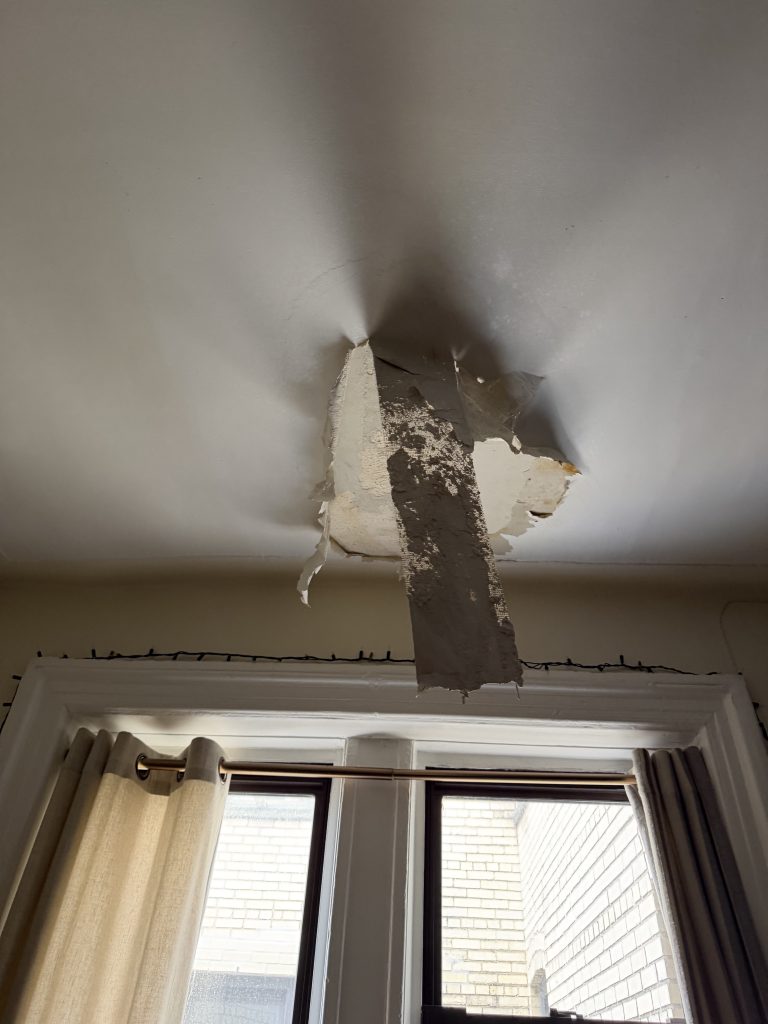
A hole in Nicole Pavez’s ceiling that’s been growing since November.
Broken elevators are a common theme across A&E’s older properties. At a six-storey A&E building in Jackson Heights that the Queens Ledger investigated in December, several elderly tenants described exhaustion and stress-related injuries brought by having to walk up several flights of stairs daily while both of the building’s elevators were out of order for six months.
At 32-52 33rd Street, both the building’s superintendent and the A&E management have been either slow or unreachable when it comes to addressing maintenance issues, Gula and Pavez said.
“It seems like as we needed more and more things from him, he got annoyed with us,” she said of the superintendent.
Gula said her attempts to reach building manager Michael Nelson about the heating issue have been unsuccessful as well.
“I didn’t receive any response,” Gula said. “I tell him all the time, ‘This is unacceptable, this is illegal, you cannot do this to us.”
Nelson did not respond to requests for comment. An unnamed A&E spokesperson responded to the Queens Ledger’s request for comment via a PR firm called Rubenstein Communications:
“Since acquiring 32-42 and 32-52 33rd Street, we have invested millions of dollars to meaningfully modernize, repair, and improve both buildings,” the spokesperson wrote. “We’ve closed thousands of work orders and addressed hundreds of violations, with additional improvements including full repiping of the gas and water systems, full electrical upgrades, boiler and burner replacements, façade restorations, roof repairs, and individualized repairs in dozens of apartments.
They continued: “That investment helps explain why building temperatures in 32-42 33rd Street have remained above the minimum threshold of 68 degrees despite some reported challenges with the heat. After a brief dip on the morning of January 28, temperatures in the building are consistently between 70 and 72 degrees. A&E continues to work diligently to address any outstanding heating concerns and ensure that all of our residents have the safe, warm homes they need and deserve.”
Safer Together
At 32-52 and 32-42, a coalition of organizations — including the Astoria Tenants Union, the New York State Tenant Bloc and Housing Justice for All — have been helping tenants canvas their buildings and add everyone to a group chat, where neighbors check in on each other when conditions are bad and coordinate collective action, such as mass 311 complaints and rent strikes. Recently, tenants from different A&E buildings around the city have been meeting for in-person assemblies to discuss strategies for how to force A&E into compliance.
According to James Carr with the Astoria Tenants Union, the goal of organizing is to both comfort tenants who are feeling alone in their decaying apartments and to formulate a long-term plan.
“It’s very scary to be in a building that you quickly realize is more or less abandoned,” Carr said. “Because if something breaks, forget it. It’s not getting fixed.”
A&E is plagued by financial troubles. In addition to several lawsuits at properties around the city, the company is in serious debt. Online databases like ACRIS and Signature Portfolio Dashboard indicate that A&E purchased 32-52 33rd Street in 2021 on a $22 million loan from Signature, a bank that folded in 2023. The debt was acquired by the Spanish bank Santander, to which A&E now owes the $22 million for 32-52, as well as an additional $8 million for 32-42.
For Pavez, who’s gone on rent strike before and is willing to do it again, her role amongst her neighbors is to inform, communicate, and support those who are less equipped to handle their circumstances than she is.
“I want to help others, because they’re struggling and maybe don’t have the same background or resources to speak up or to do anything,” she said. “A lot of people just kind of think this is the way life is.”