


ASTORIA STREET SPECTATOR: Tracing the Evolution of Democracy from Athens to Astoria

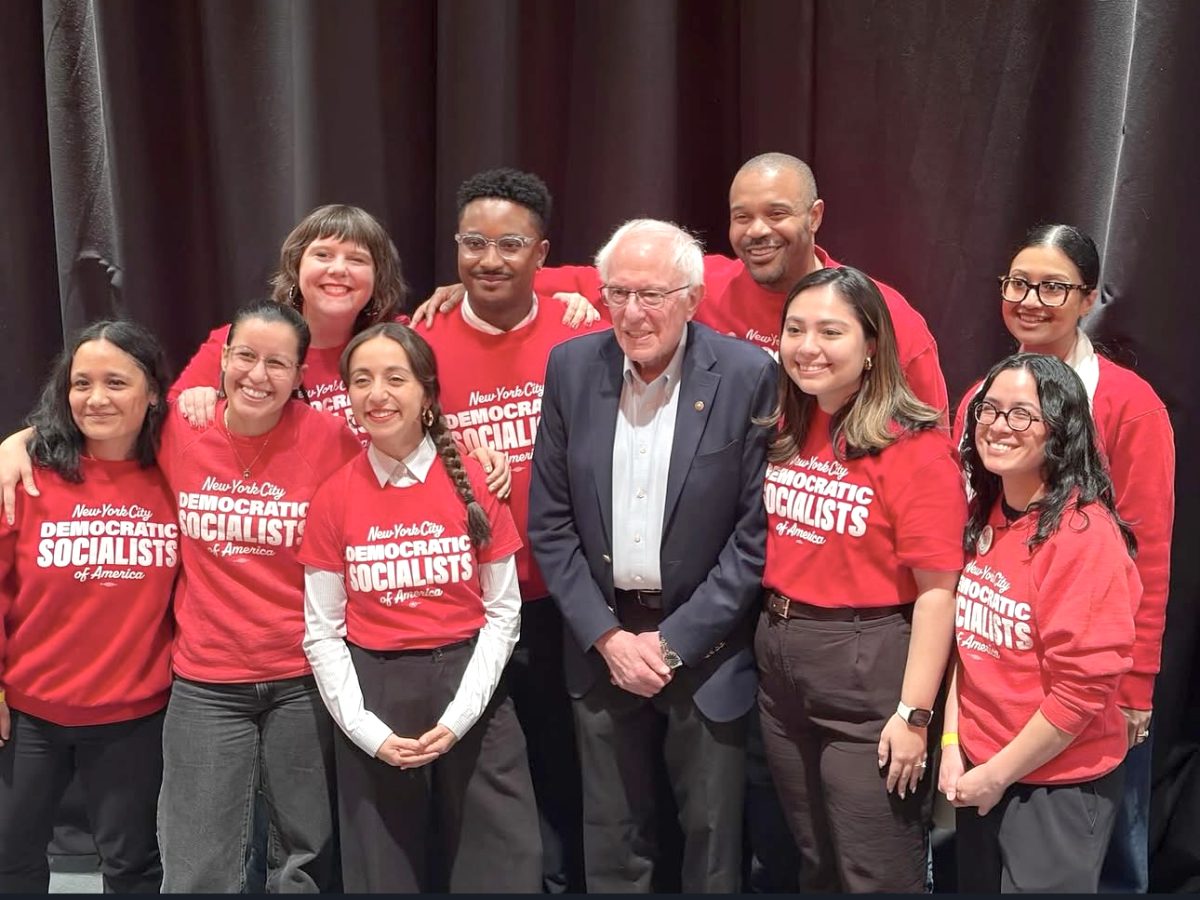
New York City’s DSA electeds with Bernie Sanders. Photo via @dianaforqueens.
NICOLAS STERGIOU
Producer, Social Media Manager, labor Organizer, and Unofficial “Astoria Street Spectator.”
In Ancient Greece, sometime around 507 BC, my people invented dmokratía—derived from demos (the people) and kratos (power or rule).
In modern English, we call it democracy. And in Astoria, Greek culture is woven into the neighborhood’s identity.
But democracy, unlike Astoria’s enduring Greek roots, is always changing.
These days, Astoria has become known for something beyond its Greek culture, its food scene, or its proximity to Manhattan. Depending on who you ask, it has earned a new nickname: The People’s Republic of Astoria.
For better or worse, Astoria has become one of the most important strongholds for democratic socialist politics in America.
What’s interesting to me isn’t whether you agree with that movement or not. It’s how it happened. I think the answer has less to do with ideology and more to do with communication.
Like many others, I started paying more attention to politics during Bernie Sanders’ presidential campaign in 2016. Bernie didn’t just run for president. He built a movement. More importantly, he built one online and in rallies and with a consistent message that focused on the power of the people instead of Super PACs.
At the time, I had friends who treated Bernie supporters like me like we had lost our minds. A few years later, some of those same friends were talking about universal healthcare, labor rights, economic inequality, and the dangers of corporate influence in politics. Welcome to the club lunatics…
Politics spreads the same way culture spreads. People share ideas with people they know. Eventually, those ideas arrived in Astoria.
Why Astoria, though? Of all the neighborhoods in New York City or the entire country, what made THIS one such fertile ground for a movement like this? I think part of the answer is that Astoria is full of people who exist somewhere between working class and professional class. We have teachers, nurses, film workers, bartenders, nonprofit employees, city workers, freelancers, immigrants, artists, and small business owners all living within a few blocks of each other. Many of us are doing okay, but we’re also staring down rising rents, student debt, and an increasingly expensive city. Astoria is educated, politically engaged, heavily online, and filled with people who spend a lot of time talking about public policy over coffee, beers, and events on 31st Ave Open Street. This part of Queens is also one of the densest concentrations of millennials and renters in any district in America, earning the nickname “The Commie Corridor” from political analyst Michael Lange. A neighborhood filled with renters is likely to think differently about housing costs, affordability, and economic security than one dominated by homeowners.
So in hindsight, it’s almost surprising this didn’t happen sooner. Like Greek culture, we are a very “social” bunch rooted in “community” (see what I did there?).
First came Alexandria Ocasio-Cortez. A bartender from the Bronx shocked the political establishment by defeating Joe Crowley in 2018, one of the most powerful Democrats in Congress. Critics couldn’t get over the fact that a bartender was suddenly on her way to Washington. Like me, she was influenced by Bernie.
Interestingly, another famous bartender who became a successful politician also in his late twenties was a man by the name of Abraham Lincoln. Do with that information what you will…
After AOC’s victory, something started shifting in Astoria politics. We saw the rise of leaders like Tiffany Cabán, Kristen Gonzalez, Zohran Mamdani, Diana Moreno, and others. More recently, we’ve seen newcomers like Aber Kawas building their own grassroots followings.
Whether you support these politicians or not, it’s difficult to ignore what they’ve managed to build. Others should take note.
I’ve had loved ones ask me, “What did AOC even do?” I’ve heard friends say the same thing about really any elected official around here.
It’s always a funny question because the answer is usually one Google search away. Bills passed. Bills sponsored. Committee work. Constituent services. The normal stuff elected officials do. But democracy isn’t something we consume like a Netflix show. It requires participation, and if you’re only checking in occasionally, it’s easy to miss the work being done. What these politicians have done particularly well is organize people through effective means of communication. As a labor organizer, that’s something I pay attention to.
Back in 2021, I became involved with a movement called Stand With Production. Our goal was to organize non-union production workers in the commercial film industry—workers who were often overlooked despite working on union sets.
It was a strange situation. Many production workers were underpaid, overworked, and lacked protections despite working alongside union crews every day. Organizing wasn’t easy.
Production workers are freelancers, which makes them difficult to organize even when the law is on our side. Traditional methods only got us so far. We needed a way to reach people directly, and social media helped us do this. We could share stories, explain issues, answer questions, and build solidarity without needing permission from anyone. We also used humor. A lot of it. Our critics dismissed our messaging as propaganda and unserious—literally in the form of letters to employers.
We got quite a bit of hate. Some thought we weren’t serious enough and they dismissed us as a “vocal minority”. But people paid attention, and attention is often the first step toward organizing. I have a different word for vocal minorities—leaders.
Eventually, we won our union card count and became official. We are now IATSE Local 111 – The Production Workers Guild.
It wasn’t easy and we were severely underestimated. Sound familiar?
People tend to dismiss social media because it can be a distraction. They complain about influencers, doomscrolling, ragebait, and short attention spans. And that’s totally fair. But social media is also one of the most powerful organizing tools ever created and Astoria’s politicians seem to understand that better than most.
During the mayoral race last year, I remember State Senator Jessica Ramos saying something during an NBC New York interview that caught my attention: “I thought I needed more experience, but turns out you just need to make good videos.”
That comment was meant as a jab at Zohran Mamdani’s online presence, but there was a deeper truth hidden behind it.
In ancient Athens, politicians spoke in public squares. In the twentieth century, they mastered radio and television. Today, they make Instagram videos, TikToks, podcasts, and livestreams.
Politicians like Mamdani have been criticized for being good at social media, as if communication is somehow separate from politics.
But I don’t think it is. Communication has always been political power.
Technology changes but the goal remains the same—Convince people to listen.
That’s why I think Astoria has become such an important political neighborhood. It’s not just producing politicians. It’s producing communicators.
Some of them will win. Some of them will lose. Some will eventually disappoint their supporters because that’s what politicians have been doing since Ancient Greece.
But when people ask, “What did they do?” I think they often overlook the most important answer.
They organized people. They built communities. They got residents involved in local politics who might otherwise have ignored it. And whether you love that movement, hate it, or fall somewhere in between, that is a form of TRUE democratic participation. You absolutely cannot dismiss it as “just good videos.” Love them or hate them, the Democratic Socialists of America have become exceptionally talented at this, and politicians nationwide seem to have taken note.
So while my Greek ancestors might not recognize the Instagram, I think they would recognize the organizing.