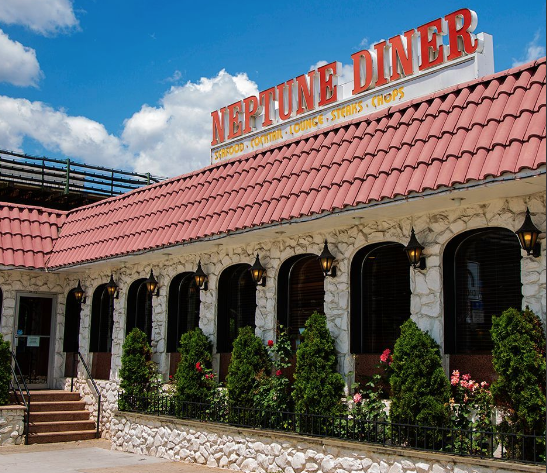
The Neptune Diner in all its former glory. Photo via @dinersofnyc on Instagram.
Diners kind of suck — and that’s why we miss them when they close.
NICOLAS STERGIOU | nicolas.stergiou@gmail.com
Producer, Social Media Manager, labor Organizer, and Unofficial “Astoria Street Spectator.
Last week, Astorians watched as Neptune Diner was bulldozed after being forced to close in July 2024 after 40 years. Almost immediately, the photos and videos of remnants started making their rounds online.
I was doomscrolling through AstoriaCentric on Facebook after Neptune Diner was demolished when I saw people commenting about how sad it was seeing old photo frames and pieces of brick sitting in the rubble. Then someone commented: “It wasn’t even good anyway.”
Earlier this week, I also came across another “What Astoria place do you miss the most?” post on the r/Astoria subreddit. The original poster and several comments mentioned Mike’s Diner, alongside nostalgic names like Igloo Cafe and Fatty’s. And of course there was an honorable mention of Neptune diner’s Avgolemono, their classic Greek lemon chicken soup
But I think people are misunderstanding the point of a diner. Diners are not supposed to be “good.” They’re supposed to be THERE. They are part of our neighborhood infrastructure.
No disrespect to diner workers. Hear me out.
Diners were never meant to compete with Michelin-star restaurants or trendy brunch spots with reclaimed wood tables. Diners are “good” in a different way. They’re dependable. They’re open at weird hours. They exist for regular people. They’re fine. A different kind of “fine” dining.
In Astoria, diners have always been part of our neighborhood’s infrastructure. Right alongside laundromats, corner stores, and old timers arguing on plastic lawn chairs about bike lanes. You knew diners would be there after a night out, after a breakup, or during a brutal hangover when your body was rejecting every decision you made the night before.
And when nobody could decide what they wanted to eat, diners solved the problem by saying: “Fine. We have everything.”
As a 2nd Generation Greek-American, diners have always felt culturally familiar to me. Greek families helped shape diner culture throughout New York City for decades. Big menus. Long hours. Fast coffee refills. Places built for workers, night owls, families, and people who just needed somewhere to sit for a while.
Astoria especially became tied to that culture. As the neighborhood grew into one of the largest Greek communities in America during the 1960s and 70s, Greek-owned diners became gathering places for workers, families, late-night crowds, and regulars who treated them almost like extensions of their living rooms. Over time, the classic Queens diner became so recognizable it even appeared in pop culture staples like Jackson Hole in Goodfellas. I think younger generations (my own included) sometimes miss the point of diners because we grew up during the rise of “food culture.” Everything now has to be optimized, aesthetic, and “TikTok ready”. Everyone’s chasing the perfect brunch spot or the hidden gem.
But diners operate under a different philosophy.
You can’t serve pancakes, burgers, chicken, a milkshakes, cheesecake, and breakfast at 3 a.m. and expect every item to taste handcrafted by an artisan chef.
The deal is FREEDOM. (Cue American Eagle “SCREEEEE”)
What if I want waffles with my steak? Or an egg in my burger? Or pasta and a gyro AT THE SAME TIME? Diners let people do that. Beautiful working-class chaos.
One of my favorite diner memories happened after a snowstorm. My partner and I walked through a snowy 23rd Street while almost everything was closed–except Bel Aire Diner.
We walked in freezing cold and ordered pancakes, eggs, bottomless coffee, and chicken strips–because we’re adults. Nothing fancy. But I will always remember it because the diner felt like a safe harbor during chaos. The kind of place that quietly tells you: “Yep. The world’s a mess right now. Sit down. Coffee?”
And nowhere do I see diner culture more clearly than in my own industry.
I work in film production, and film crews here run on diner coffee and a filling breakfast. People glamorize the entertainment industry, but most crews operate more like blue-collar workers than celebrities. We wake up at absurd hours, work long shifts, and often report to a diner before sunrise to catch the company shuttle van to locations nowhere near public transportation.
If we were heading to Jersey, it’s Tick Tock Diner. Long Island? Kellogg’s Diner. For years, if we were heading north, it was Neptune Diner because the Triborough Bridge is RIGHT there. Many days in my early film career started before dawn at Neptune, coffee in hand before a 12-hour shoot day.
Part of my job sometimes is curating local recommendation lists for incoming producers and directors from Los Angeles. My restaurant suggestions often get rejected for not being trendy or upscale enough. It makes me feel defeated as a New Yorker.
But one thing that always stuck with me was working on “The Amazing Race.” The executive producer, Bertram van Munster — originally from the Netherlands — ALWAYS wanted to go to a diner. Not a rooftop. Not a tasting menu. An old-school “Great American Diner.” Something about that stayed with me. Here’s a guy who LITERALLY travels the world and still wants diner coffee in a thick white mug and fried eggs in New York.
I don’t think Americans realize how iconic diners are until somebody from somewhere else reminds us.
Because before a 14-hour workday, people need somewhere to sit quietly with coffee under fluorescent lights while questioning their life choices at 4:30 in the morning.
That’s diner culture. And sadly, that culture is disappearing. In fact, New York City has lost roughly 60% of its diners in less than 30 years. The classic neighborhood diner — once one of the defining symbols of New York life — is quietly disappearing in real time.
There are plenty of places left in Astoria to get a good meal. But there are fewer and fewer places that just let people exist without rushing them out the door.
That’s why watching Neptune get demolished felt emotional for so many people. Not because it had the best food in Queens. But because places like that quietly carry part of the neighborhood’s soul. And when one disappears, you realize diners were never really about the food. They’re about late nights. Early mornings. Coffee before work. Pancakes after heartbreak. Snowstorms. Hangovers. Film crews. Families. The working class.
They’re about New York.
They’re about America.
Enjoy them while you can, Astoria.