


Search
There are no ads matching your search criteria.

Love, Brunch, and Slasher Horror

A Valentine’s Day brunch with the Astoria Horror Club. 

By MARYAM RAHAMAN 

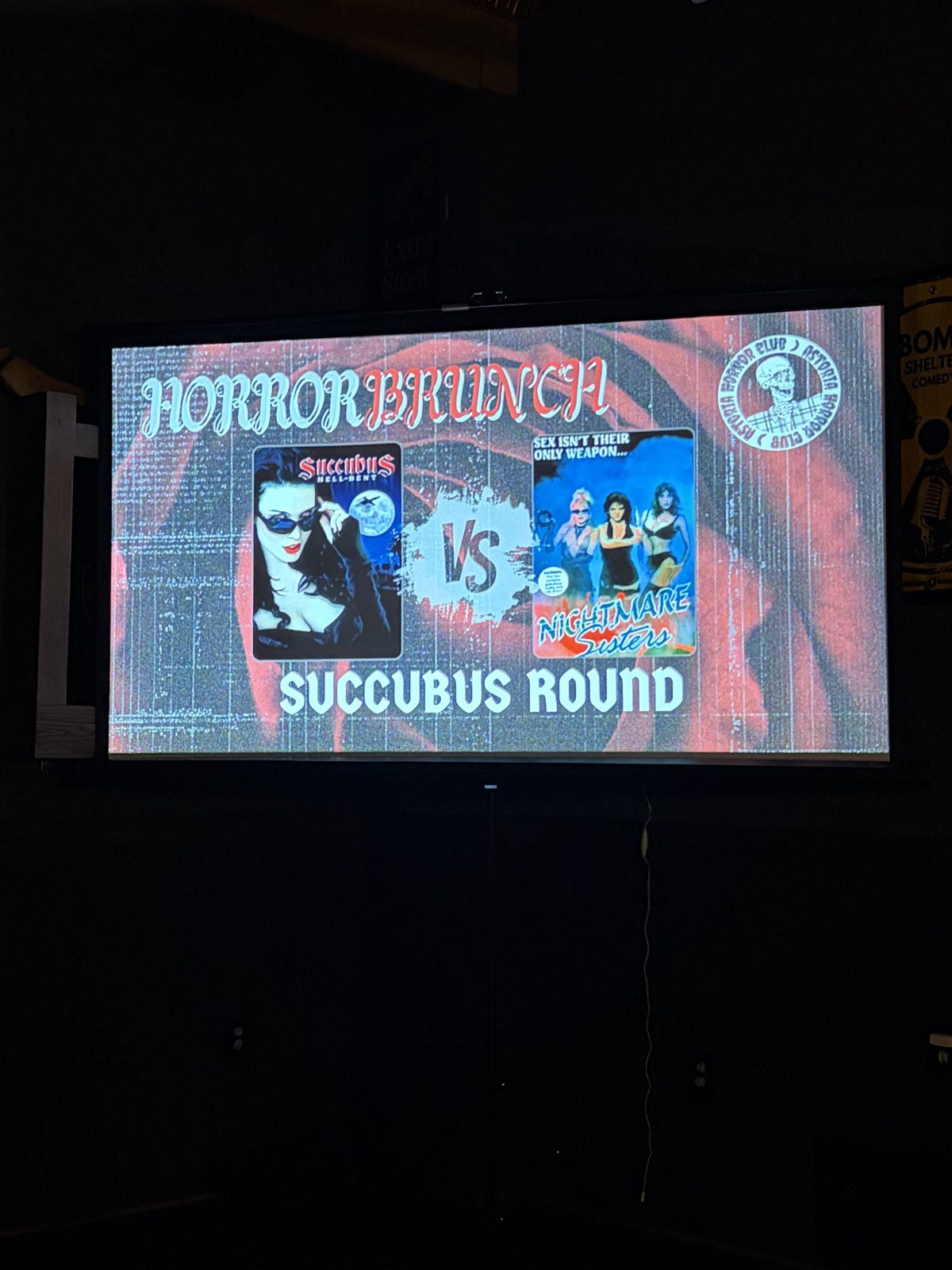
ASTORIA — Love — and jumpscares — are in the air. Visitors in search of both made their way past the bar at Shillelagh Tavern through a set of dark curtains. On the other side, a back room filled with horror fans greeted them. Audience members voted to watch “The Phantom of the Mall: Eric’s Revenge,” a low-budget ’80s slasher loosely inspired by “The Phantom of the Opera”. The ambience was akin more to a very large friend group on a couch making quips and offering commentary than that of a movie theater.

The event was the Valentine’s Day themed “Horror Brunch on Sunday,” a movie marathon hosted by the Astoria Horror Club. Founded in 2021 by married couple Mary Snow and Tom Herrmann, the club regularly meets for movie screenings and book club meetings. Though the event was “BYOB,” or “bring your own brunch,” a table brimming with several kinds of cereal, coffee, and pastries was also available to all audience members.

The club was founded after Herrmann posted on the Astoria subreddit asking if anyone would like to watch horror movies at a bar. He was itching to expand his social circle as lockdown restrictions eased up. Though other meet-ups existed, they felt less personal.  His post gained over 100 comments, with people offering to volunteer time and venues right away. Even in record-low temperatures, the event brought out about two dozen people.

“It’s a niche right? Not everybody likes horror, but the people who like it typically love it,” Herrmann said. “We have a pretty strong queer community at the horror club community, and I think that has something to do with feeling misunderstood, out of place, different. I think that horror speaks to that.”

Outdoor screenings at Astoria’s Heart of Gold bar have produced such enticing laughter that non-horror buffs have converted. “We’ve also had people who’ve come, who said that they came even though they don’t like horror because they could hear us,” Snow added. “They’re like, ‘They’re having fun. I want to go have fun.’ And now they’re regulars.”
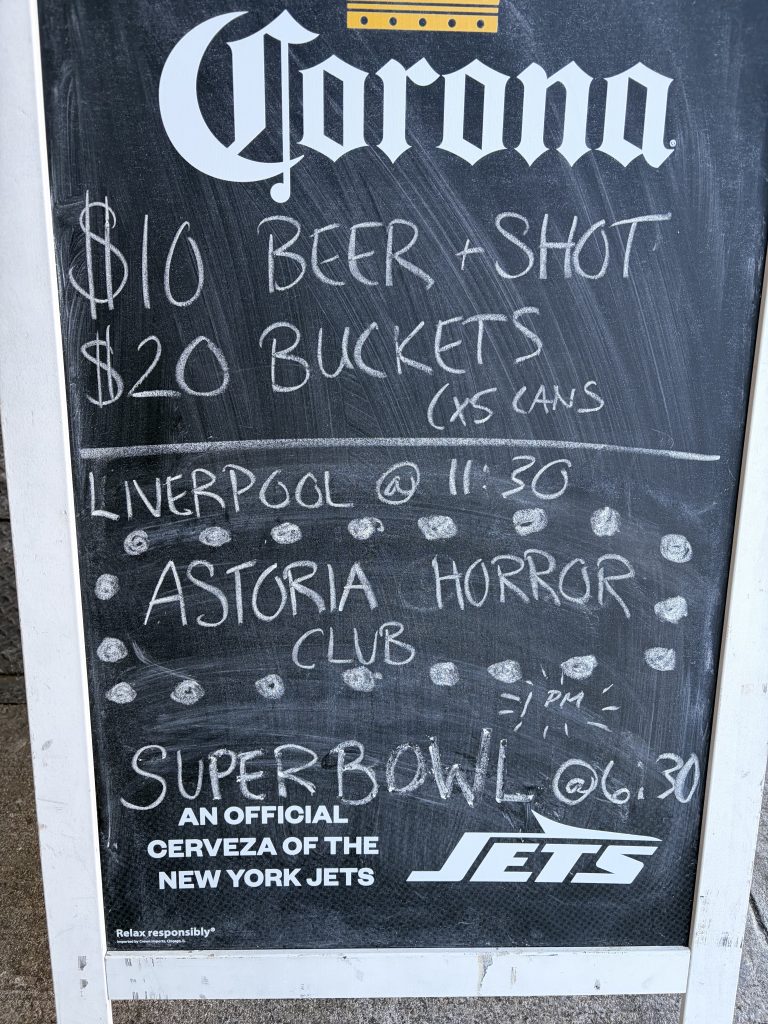
The first movie followed teenager Melody after the supposed death of her boyfriend Eric in a mysterious fire. The Valentine’s Day tie-in? While Eric is revealed to be alive and taking revenge against those responsible for his death, Melody is falling in love with Peter, the reporter investigating it. Chatter among attendees and commentary from a Liverpool match being played in the main bar spilled into the movie room. But the sound of the speakers soon drowned it out as the undead Eric took the life of his first victim. The sweet smell of nutella crepes, one viewer’s choice for brunch, accompanied the death scene .

Overall, the movie provoked more laughs than scares. The first time Eric took off his mask, an audience member jeered, “Leave it on!” The crowd responded with a collective “Ew” at Melody and Peter’s celebratory kiss at the end, after Eric and all other villains had been eliminated.

“Horror isn’t the first genre people associate with Valentine’s Day, but there are a lot of great horror movies that deal with romance, love, affection, loss of a loved one,” Herrmann said.

Married couple Mary Snow and Tom Herrmann bonded over their shared love of horror films. Photos by Maryam Rahaman.

Snow and Hermann themselves bonded over a Halloween theater reboot early in their relationship. The pair got married on Friday the 13th, in a wedding that included  references to slasher films.

On Sunday, Blaxploitation film “Sugar Hill,” followed the previous slasher. The main character Diana took vengeance against her fiancé’s killers with the help of a voodoo priestess. Unlike the bursting laughter the first film generated, the vibe during the second was more subdued. Nightmare Sisters,” a B-movie Herrmann described as “barely a movie” was the third and final edition of the screening.

Snow emphasized that Horror Club is a community space “open to everybody,” but that one of three main rules is to “let people watch the film.” Viewers are free to joke around during more fun films, but should be more respectful during serious ones. Viewers must also be good guests to the venues hosting, and are expected to hang out and talk to someone new every time. Though the last isn’t a hard-and-fast rule.

To learn more,  check out @astoriahorrorclub on Instagram. All Horror Clubs events are totally free, but the couple also hosts low-cost screenings under the banner Zero Vision Cinema to access venues with better facilities and to promote local artists and films.

In the upcoming weeks, Snow hopes that the group can contribute to community organizing. Currently, the pair is working on pairing with groups organizing against ICE. After Trump was inaugurated, they said they felt a sense of “hopelessness” in the community. As many movie theaters are struggling, the Astoria Horror Club hopes the bonds created laughing, screaming and crying together at screenings can offer some respite.

“We believe in the community of cinema,” Herrmann said. “To be able to create spaces where people can come together with a common interest in horror and be able to just interact with strangers or people they might not super well is a really great thing we can give to the community. And we feel very lucky to have such an excellent community around us.”
Diana Moreno Dominates in AD36 Win

By COLE SINANIAN  | news@queensledger.com

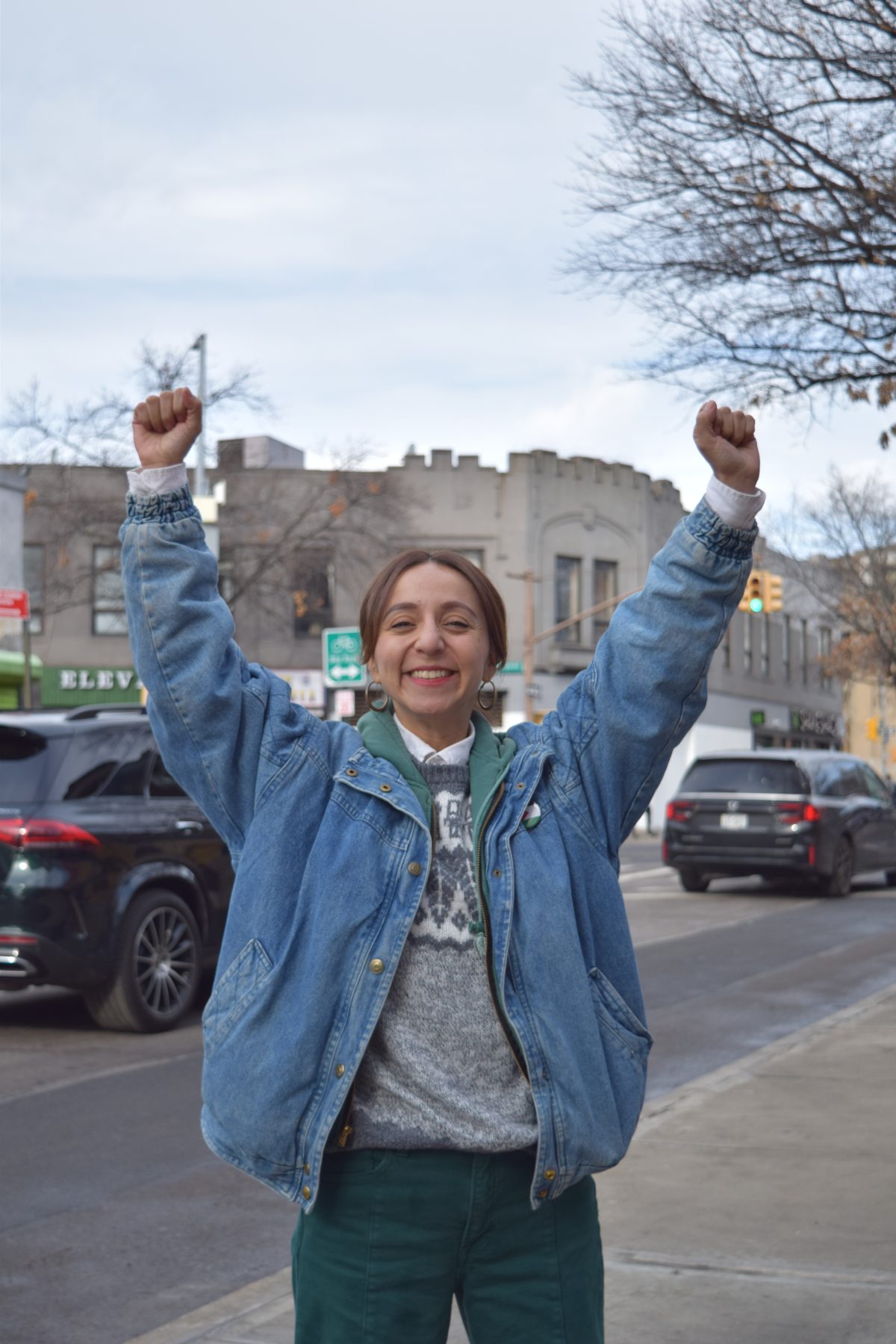
ASTORIA — Diana Moreno wasted no time in starting her new job.

Only hours after winning a landslide victory against Assembly District 36 opponents Rana Abdelhamid and Mary Jobaida on February 3 with 74% of the vote, Astoria’s newest Assemblywoman zipped up to Albany for the first legislative session of her term, where she co-sponsored the New York For All Act, a bill that would prohibit state law enforcement from collaborating with federal immigration agents.

Moreno, a DSA-backed lifelong organizer and new mom originally from Ecuador, made immigrant safety a key part of her campaign. Also key was her laser focus on the same affordability platform that won her predecessor Zohran Mamdani the mayorship. Just days into her tenure in Albany, Moreno is already well on her way to making good on at least one of her campaign promises.

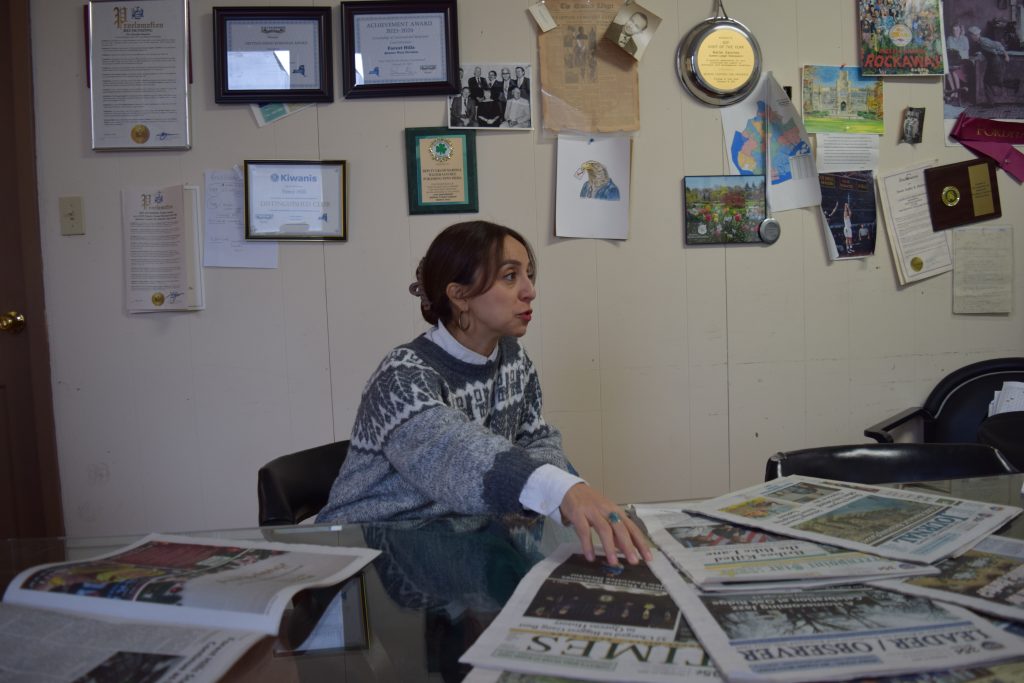
“We cannot be complicit as New York State in the human rights abuses and in the abuses of law that ICE  agents are engaging in,” Moreno said during an interview at the Queens Ledger office last month.

Moreno, who was favored to win the race after securing key endorsements from NYC-DSA, NYC Working Families Party, and the Queens Democratic Party in a rare, three-way alignment from the city’s most prominent left-wing political organizations, has been praised by political allies for her steadfast solidarity with working people and her proximity to the communities she advocates for.

“I’ve been in rooms with Diana filled with undocumented construction workers,” said US Representative Alexandria Ocasio-Cortez during an election night event in Astoria. “She fought not on behalf of them, but fought with them. She helped them create power out of no power. That’s magic. That’s what organizing is.”

Diana Moreno stopped by the Queens Ledger office in January, where she called on state legislators to put working people first.

The race for AD 36 — the first since Mamdani’s election — was characterized by some political commentators as the first test of the new mayor’s political might. The three candidates — all of  whom have at one point been DSA members  — espoused remarkably similar ideologies, each running on the promise of affordability for working people and immigrant and labor rights. But it was Moreno, who had previously served as co-chair of the Queens DSA chapter, that got the coveted endorsement from NYC-DSA, which quickly threw the full force of its army of canvassers behind her. Days later Mamdani followed suit, all but sealing the deal on her election.

Abdelhamid and Jobaida, who ran on independent tickets, earned 17% and 8% of the vote, respectively. In a post to social media Tuesday, Abdelhamid conceded and thanked her campaign team for their hard work:

“Proud of everyone who believed in our vision, knocked on doors, made calls, and showed up to vote,” she said. “You proved that grassroots organizing builds real power.”

Moreno, who came by the Queens Ledger office in January to discuss her legislative agenda and her position in the wider DSA movement, has described herself as a loyal successor to Mamdani who will work tirelessly to champion his agenda in the state legislature. She spoke of a political and economic system that prioritizes profit for the few over the needs of the many, and vowed to use her office to help working-class New Yorkers access a comfortable and dignified life.

“We really have a system that is not working for working people, where we have to ask ourselves, how do we build an apartment where a family of four can live and pay rent?” Moreno said.  “Just the fact that we have to ask ourselves that question points to the fact that this system is rigged for working people. We have a part to play in the New York government to un-rig that system.”

With three openly socialist candidates in one race, even if Moreno hadn’t won, there was little doubt that Mamdani’s successor in Astoria would be a socialist. The so-called “People’s Republic of Astoria” — a nickname that’s become a bit of a trope in recent months — has been a DSA stronghold since at least Mamdani’s election to the Assembly in 2020, at which point it became the only administrative district in America to have elected socialists at the municipal, state, and federal levels (Ocasio-Cortez is the neighborhood’s congresswoman, while Tiffany Caban is its City councilmember).

But as NYC-DSA looks to flood the State Assembly with a new crop of fresh-faced socialists come primary elections on June 23, the organization will face perhaps the first major test of its electoral organizing power since Mamdani’s upset victory in November.

In Brooklyn, DSA-members Christian Celeste Tate and Eon Huntley are running to unseat Democrats Erik Dilan in AD 54 and Stefani Zinerman in AD 56, respectively. In Harlem, public defender Conrad Blackburn is running to replace Democrat Jordan Wright in AD 70, while in Queens, lawyer and union organizer David Orkin is vying for AD 38, a seat currently occupied by Democrat and former Mayor Adams ally, Jenifer Rakjumar.

DSA-backed congressional candidate and District 37 Assemblywoman Claire Valdez, who hopes to replace the locally beloved US Rep. Nydia Velazquez, faces an even tougher primary fight. She’ll be up against Brooklyn Borough President Antonio Reynoso, who’s a popular progressive endorsed by Velazquez herself, as well as Sunnyside and LIC City councilmember Julie Won, who announced last week that she would enter the race on a similarly progressive ticket.

A&E Tenants Left In The Cold As City Cracks Down On “Worst Landlord”

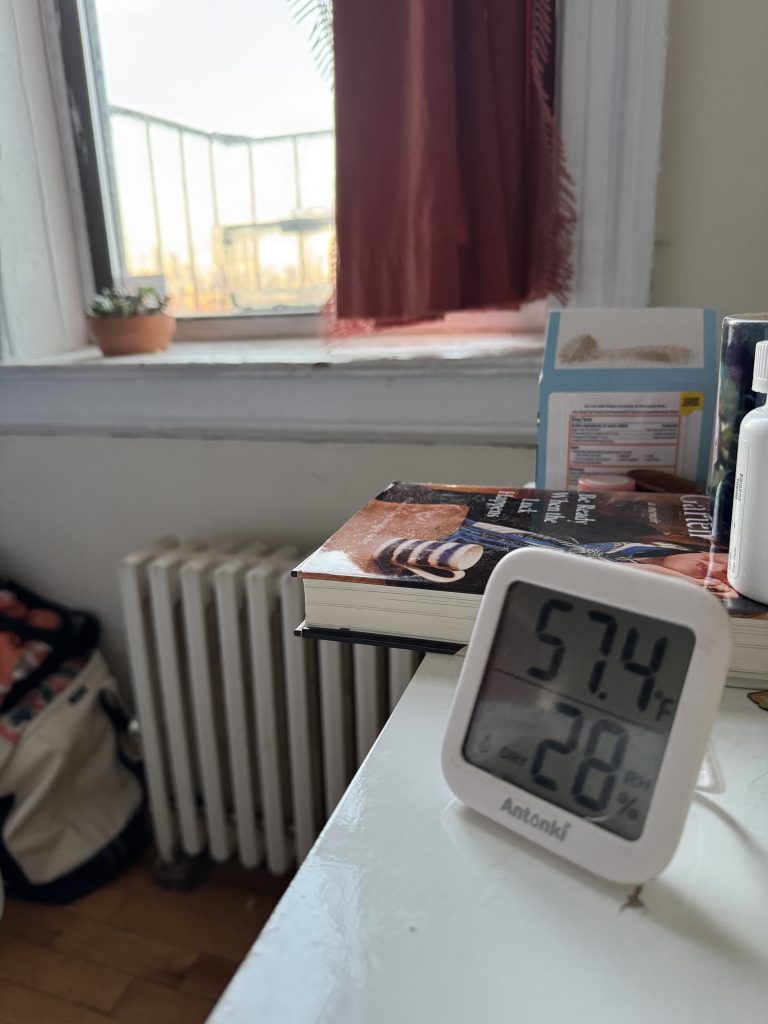
The temperature inside Josi Gula’s apartment regularly dips below 60 degrees each winter.

By COLE SINANIAN  | news@queensledger.com 

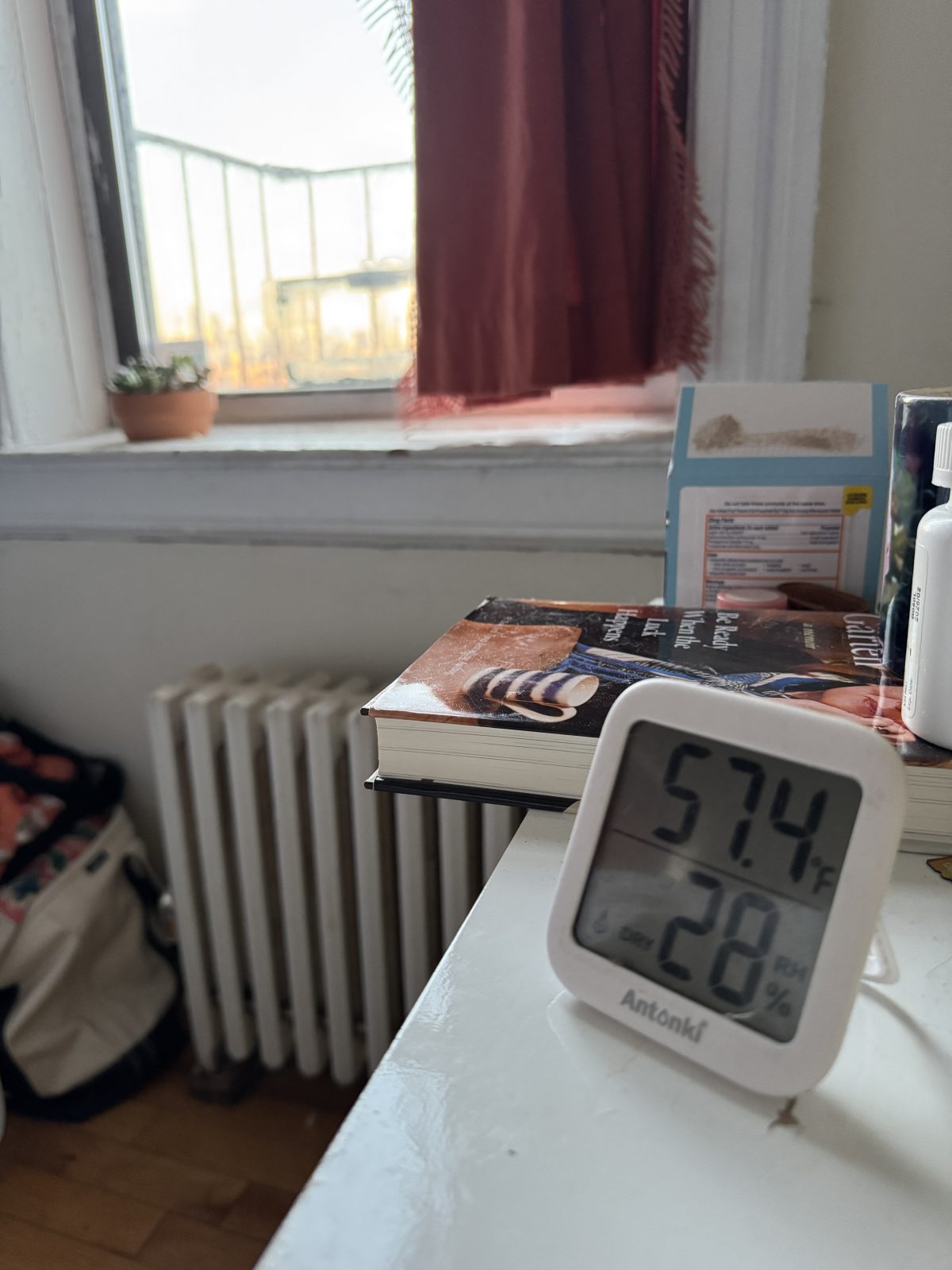
ASTORIA — When the outdoor temperatures plunged into the single digits last week, Josi Gula was shivering in her bed as the mercury in her apartment hit 56 degrees fahrenheit for the third year in a row.

Each winter since 2024 her heat would turn on and off sporadically — sometimes for long periods — often leaving her and her husband freezing in their one-bedroom apartment.

Gula lives at 32-52 33rd Street in Astoria, in a six-storey, 98-year-old building owned by the notorious landlord A&E Real Estate holdings, a company whose CEO — Margaret Brunn — was named NYC’s “worst landlord” of 2025 by Public Advocate Jumaane Williams. A&E, which has nearly 70,000 Housing Preservation Department (HPD) violations across its 181 buildings throughout Manhattan, Queens, Brooklyn and The Bronx, is the subject of a $2.1 million settlement with the City announced in January. The money will go towards restitution to tenants for the company’s alleged harassment, and the city has ordered A&E to correct violations at the 14 buildings included in the settlement.

But tenants in Astoria, who are reporting major heating outages and negligent management at 32-52 33rd and its adjacent building, 32-42, are wondering when they’ll get their turn for justice.

City law requires landlords to heat their buildings when the daytime temperature outside drops below 55 degrees. If the nighttime temperature inside drops below 62 degrees while the outside temperature is below 55, HPD can issue a violation.

Too Cold, Too Hot

Gula, a salon manager who’s lived at 32-52 33rd Street for the past five years, said since January 27 the heat in her apartment has consistently turned off overnight. And she isn’t alone. Gula’s neighbor, a city worker named Nicole Pavez, told the Queens Ledger that things have only gotten worse since she first moved into the building in 2023.

In January of 2024, the heat in her apartment began to fail, turning off at night then turning on and off sporadically throughout the day. Like Gula, Pavez installed a thermostat and reported the heating outages to HPD. When the building’s heat is working, Pavez said, it works too well. One day in January 2025, the thermostat in her apartment hit 97 degrees fahrenheit. She also recalled multiple circumstances when HPD inspectors came to investigate heating complaints, only to find the heat miraculously working again.

“This year we’ve been pretty good so far, up until last week,” Pavez said. “Two consecutive nights we were freezing. There was no heat at all.”

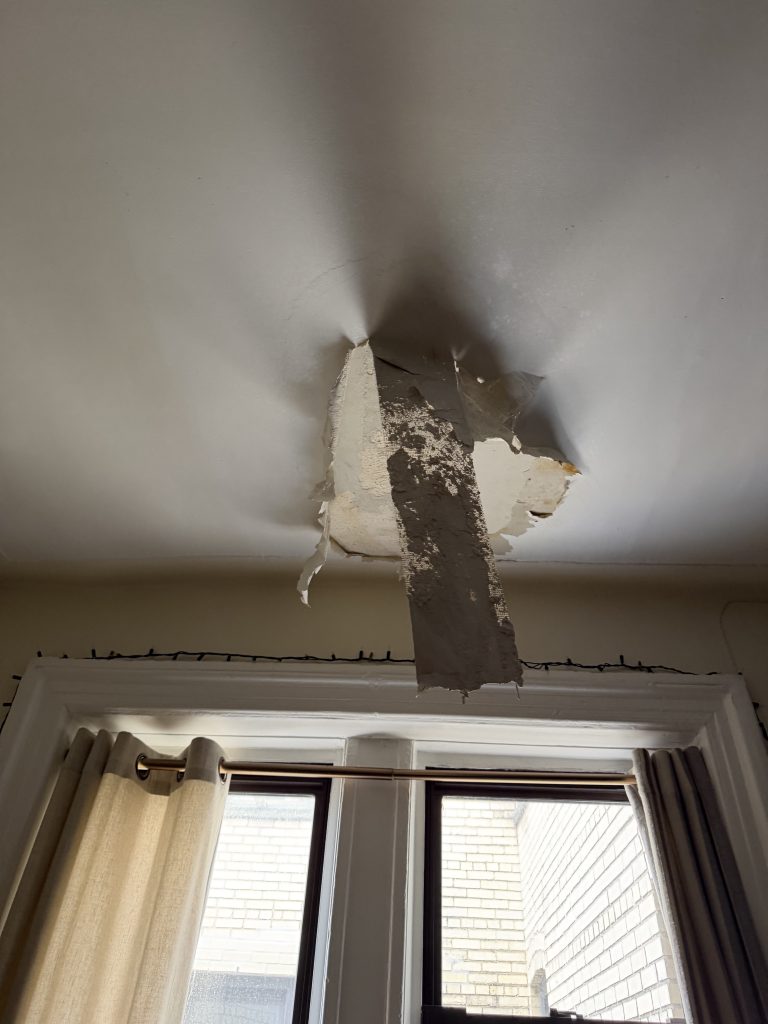
And heat isn’t the only problem. In Pavez’s apartment, there’s an enormous, peeling hole in her ceiling, caused by a leaking radiator in the apartment above. It appeared in November, Pavez said, and has grown over the past few months. Despite her submitting an HPD complaint, management has not yet fixed the hole.

Both Gula and Pavez described frequently broken elevators, a major risk for the building’s many elderly. The last time they broke was around Thanksgiving, Gula said. She described witnessing a neighbor help an elderly, normally wheelchair-bound man slide down the staircase on his buttocks.

A hole in Nicole Pavez’s ceiling that’s been growing since November.

Broken elevators are a common theme across A&E’s older properties. At a six-storey A&E building in Jackson Heights that the Queens Ledger investigated in December, several elderly tenants described exhaustion and stress-related injuries brought by having to walk up several flights of stairs daily while both of the building’s elevators were out of order for six months.

At 32-52 33rd Street, both the building’s superintendent and the A&E management have been either slow or unreachable when it comes to addressing maintenance issues, Gula and Pavez said.

“It seems like as we needed more and more things from him, he got annoyed with us,” she said of the superintendent.

Gula said her attempts to reach building manager Michael Nelson about the heating issue have been unsuccessful as well.

“I didn’t receive any response,” Gula said. “I tell him all the time, ‘This is unacceptable, this is illegal, you cannot do this to us.”

Nelson did not respond to requests for comment. An unnamed A&E spokesperson responded to the Queens Ledger’s request for comment via a PR firm called Rubenstein Communications:

“Since acquiring 32-42 and 32-52 33rd Street, we have invested millions of dollars to meaningfully modernize, repair, and improve both buildings,” the spokesperson wrote. “We’ve closed thousands of work orders and addressed hundreds of violations, with additional improvements including full repiping of the gas and water systems, full electrical upgrades, boiler and burner replacements, façade restorations, roof repairs, and individualized repairs in dozens of apartments.

They continued: “That investment helps explain why building temperatures in 32-42 33rd Street have remained above the minimum threshold of 68 degrees despite some reported challenges with the heat. After a brief dip on the morning of January 28, temperatures in the building are consistently between 70 and 72 degrees. A&E continues to work diligently to address any outstanding heating concerns and ensure that all of our residents have the safe, warm homes they need and deserve.”

Safer Together 

At 32-52 and 32-42, a coalition of organizations — including the Astoria Tenants Union, the New York State Tenant Bloc and Housing Justice for All — have been helping tenants canvas their buildings and add everyone to a group chat, where neighbors check in on each other when conditions are bad and coordinate collective action, such as mass 311 complaints and rent strikes. Recently, tenants from different A&E buildings around the city have been meeting for in-person assemblies to discuss strategies for how to force A&E into compliance.

According to James Carr with the Astoria Tenants Union, the goal of organizing is to both comfort tenants who are feeling alone in their decaying apartments and to formulate a long-term plan.

“It’s very scary to be in a building that you quickly realize is more or less abandoned,” Carr said. “Because if something breaks, forget it. It’s not getting fixed.”

A&E is plagued by financial troubles. In addition to several lawsuits at properties around the city, the company is in serious debt. Online databases like ACRIS and Signature Portfolio Dashboard indicate that A&E purchased 32-52 33rd Street in 2021 on a $22 million loan from Signature, a bank that folded in 2023. The debt was acquired by the Spanish bank Santander, to which A&E now owes the $22 million for 32-52, as well as an additional $8 million for 32-42.

For Pavez, who’s gone on rent strike before and is willing to do it again, her role amongst her neighbors is to inform, communicate, and support those who are less equipped to handle their circumstances than she is.

“I want to help others, because they’re struggling and maybe don’t have the same background or resources to speak up or to do anything,” she said. “A lot of people just kind of think this is the way life is.”

NY Irish Center Calls LIC Home

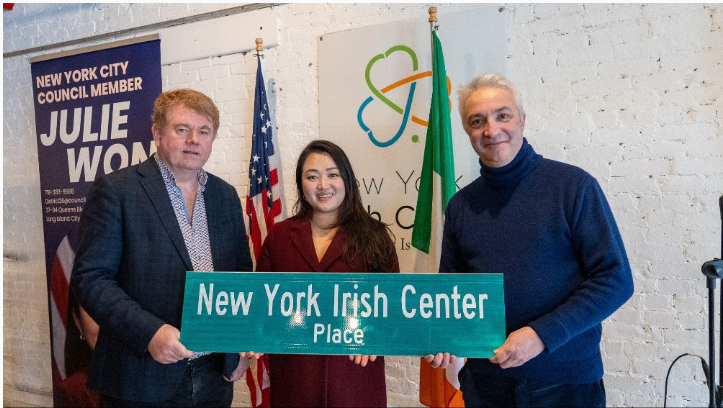
LIC City councilmember Julie Won (center) said she had fond memories of the local Irish community welcoming her family after they immigrated from Korea.

A section of Jackson Avenue was renamed ‘New York Irish Center Way’ in honor of the generations of Irish that have called NYC home. 

GEOFFREY COBB | gcobb91839@Aol.com

Author, “Greenpoint Brooklyn’s Forgotten Past

LONG ISLAND CITY  — It was a bitterly cold day on Saturday February 7th for the celebration of the renaming of the stretch of 1040 Jackson Avenue as New York Irish Center Place, but the Irish are a hardy bunch. About seventy brave souls defied the seven-degree day and subzero wind chill to watch City Councilmember Julie Won unveil the new street sign.

Won spoke of how her family, which immigrated from South Korea, was warmly greeted by the Irish community when she arrived in Queens as an eight-year-old. She related how Irish mothers passed on educational advice to Won’s mother and how supportive and welcoming the Irish community was to newcomers to Queens.

“It is important to honor the Irish who have done so much to build our community,” Won told me. Won has helped the center receive over $500,000 in grants. She said that last year alone a mind boggling 25,000 people came to the center, including many outside the Irish community.

The Center hosts three annual programs. In March it stages 40 Shades of Green, a Saint Patrick’s Day cultural marathon celebrating Ireland’s patron saint.  Along with Culture Lab LIC & McManus Irish Dance, the center presents the Queens Irish Heritage Festival as well. A world music series called Crossroads Concerts blends and juxtaposes Irish folk traditions with music from many other cultures.

Forty-three different organizations use the center for programming like Irish dance classes and Gaelic language and literature events, but the center’s outreach also includes non-Irish groups that serve the larger community including suicide prevention services, alcoholic anonymous meetings, immigration counseling and an ever-expanding list of others. The center welcomes people of all races, ethnic backgrounds and faiths. Last year, for example, eighteen Indian American events took place at the center. The center also teamed up with  Councilmember Won to raise more than $14,000 in a Christmas toy drive for underprivileged children.

For Twenty-one years, the Irish Center has served as the beating heart of New York City’s Irish community. The idea for the center was conceived by Belfast native Fr. Colm Campbell who saw a need for a place for the Irish community to gather. Angela Reily, the widow of legendary Irish folk singer Paddy Reilly addressed the audience on Saturday: “My husband would be happy to see how successful the center has become,” she said. The singer was instrumental in raising money for the center and helping to found it. Following a long and hard structural renovation and generous gifts from local Irish building contractors, the Center opened its doors in 2005.

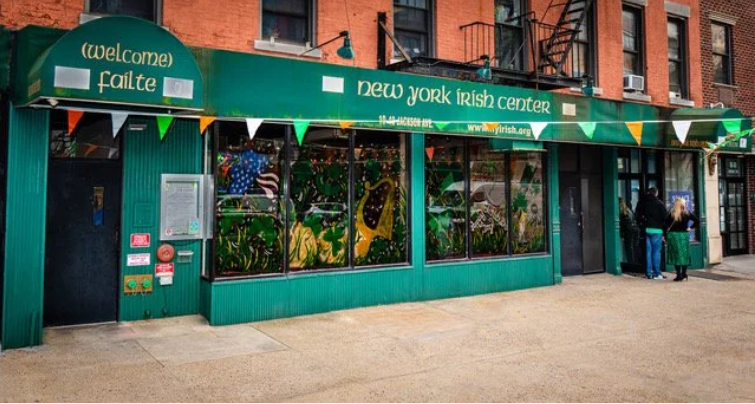
The Irish Center first opened its doors in 2005, and has since become a crucial gathering place for the city’s Irish community. Photo via newyorkirishcenter.org

The director and beating heart of the New York Irish center is Limerick-born George Heslin, who has run this multi-purpose community center for five years. Prior to his appointment, Heslin served for 19 years as founding Artistic Director of off-Broadway’s Origin Theatre Company. Warm, personable and capable, Heslin is also a recipient of the Irish Examiner/New York Man of The Year Award.  Though Heslin is modest, he proudly noted, “No other Irish organization does what the New York Irish Center does.”

Heslin says that first and foremost the center is a social service organization. The center radiates a typically Irish ability to welcome people, which Heslin demonstrates in his love for people, especially many of the Irish senior citizens for whom the center is a social lifeline.  He describes his work helping Irish seniors living out their lives overseas as a “privilege,” and said that the center plans to create more programs to cater to the needs of older Irish people including new programs in grief counseling and befriending seniors. Many of these seniors now have no living relatives in Ireland and the center is their only true connection to the land of their birth.  Dozens of these Irish seniors look forward to the lunch the center serves them each Wednesday.

Heslin and his small staff have worked hard to expand the cultural offerings the center stages, including traditional Irish music, dance and theater. Last year the center staged an astounding 160 events, which paid some four hundred artists who performed at them. Stageandcinema.com described the vibe at performances there as “ a bit like stumbling into a well-kept secret; it’s an intimate gathering place and an unassuming, cozy, cultural enclave.” The New York Irish Center is much more than a home to the New York Irish community. It is a home for thousands of New Yorkers, many of whom are not even Irish.  As former Executive Director of the New York Irish Center Paul Finnegan remarked, “It is fitting that this section of Jackson Avenue will now be called the NY Irish Center Place because it is home to an inclusive, caring community in a building built lovingly with the hands of its past and present generations.”

Fill the Form for Events, Advertisement or Business Listing